Click here to sign up for our free daily newsletter
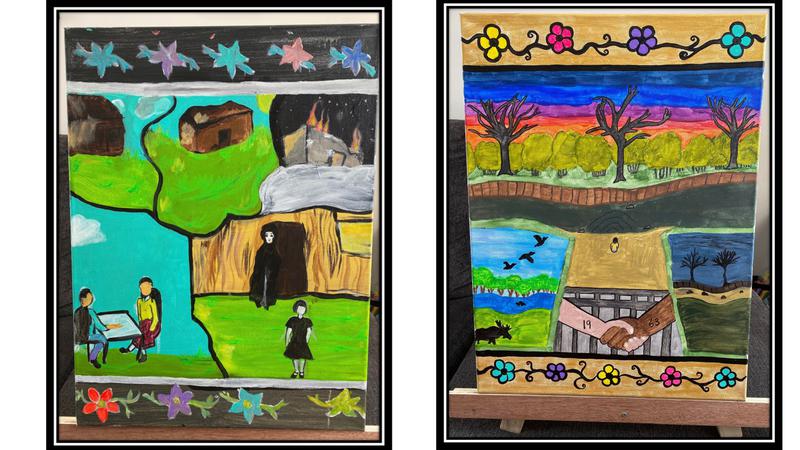
Artwork by Kimione Peekeekoot (left) and Kain Torgerson (right). (Heritage Saskatchewan)
Cultural Art

Cumberland students win education bursary for storytelling and artwork on culture

Jun 7, 2022 | 3:00 PM

The storytelling by two Cumberland House students and artwork by two others is being recognized through a provincial competition.

Heritage Saskatchewan recently released the inaugural winners of their High School Heritage Challenge where kids in Grades 9 and 12 were given the chance to share stories about Canadian heritage.

Three winners were chosen, including Tavian Stewart’s story ‘History of Pine Bluff’, artwork done by Kimione Peekeekoot, and Christopher Deschambeault-Morin’s story “The Ripple of Time’, artwork done by Kain Torgerson.

The two stories each won a $1,000 education bursary.

History of Pine Bluff

This submission is a collection of stories from Stewart’s gran.

She shared memories from her life on Pine Bluff, their homeland, from playing sports to trapping. She also told the story of when her school burned down and soon after was sent to a residential school.

“She told me about her teenage years in the residence, one night when her and her friends were going to get pop out of the pop machine after supper, they saw these ghostly figures moving in the darkness of the long empty hallway. She told me that it was the ghosts of the many kids who passed away there.”

Stewart’s story ends with him mentioning he and his family continue to travel to Pine Bluff, despite the fact that only one building remains up.

“It may just look like a campsite to others, but to me and my gran, it will forever be our homeland.”

(YouTube/Mika Carriere)

The Ripple of Time

Deschambeault-Morin’s story focuses on the past and present of his culture through the different bodies of water.

This includes the Big Stone River, a place he believes is no longer healthy but rather ‘dark and dirty.’

“It was not always like this; at one time the water was so beautiful and clear, so much so that it was said that you could stand on the shoreline and see the fish swimming clearly through the water.”

“As I stand on the shoreline now and look at the condition of our water, rivers, and lakes in the Cumberland House Delta, many of the fish species have died off due to disease or poor health. No longer can you catch the monsters of the delta.”

He also touched on the negative effects dropping water levels are having on the land.

“Our land is no longer getting the nutrients it needs to thrive from the river water; our land, much like our river, is dying.”

Deschambeault-Morin’s story was meant to raise awareness for land, water, culture, and Indigenous lifestyle.

(YouTube/Mika Carriere)

Jaryn.Vecchio@pattisonmedia.com

On Twitter: @princealbertnow