Click here to sign up for our free daily newsletter
Saskatoon MLA and Associate Shadow Health Critic Keith Jorgenson met with reporters outside a health clinic in Prince Albert. (Image Credit: Nigel Maxwell/paNOW Staff)
Health alerts

Sask NDP sound alarm over TB cases in northern Saskatchewan

Apr 2, 2026 | 5:09 PM

Claiming the provincial government is hiding an active Tuberculosis outbreak, the Saskatchewan NDP is calling for better reporting and more transparency.

Keith Jorgenson, Associate Shadow Health Critic, met with reporters in Prince Albert on Thursday.

“This is a very serious disease,” he said. “Keeping this information from the public is not just neglectful — it’s dangerous.”

Internal provincial health authority information shows that there were 22 cases of Tuberculosis (TB) diagnosed between January 1, 2025, and February 28, 2026, across Prince Albert, Nipawin, Sandy Bay, and the surrounding areas. 

Jorgenson stated Tuberculosis, like scurvy, should be a disease of the past, and is a highly treatable disease.

“And the fact that the government has known about a TB outbreak in PA for over a year and has done nothing to treat the outbreak and prevent it from spreading, is alarming,” he said.

Tuberculosis is a serious, contagious airborne infection and has affected northern Saskatchewan communities in particular due to overcrowded housing, limited access to healthcare, poverty, and barriers to early diagnosis and consistent treatment. 

When asked what the NDP would do differently, Jorgenson said the general public has an immediate right to know when there is an outbreak and people who may have been in close contact should be alerted so they can take preventative measures.

The province’s Chief Medical Health Officer Dr. Saqib Shahab was answering questions about TB at the Legislature. He explained every month there’s a handful of cases that get reported and the most common are new people to Canada and Indigenous people living in northern communities.

“At this point there should be no concern about a spread,” he said, explaining TB is not infectious like Measles or other respiratory diseases and requires prolonged contact.

“We don’t expect to see people with infectious TB just walking around.”

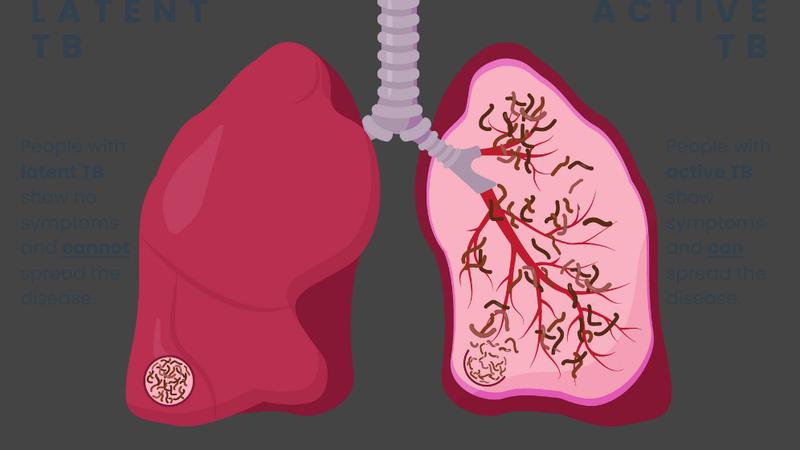
A graphic of latent TB and Active TB in lungs.
A graphic of latent TB and Active TB in lungs. (Image Credit: Info graphic/NITHA website)

Dr. Shahab explained in Canada we have great medicine for treating TB and the treatment takes about six months. He also assured that when a new case is found, that person is immediately treated and the active tracing commences which works to eliminate the transmission cycle.

When asked why the cases reported by the NDP were not made public, Shahab explained a high degree of sensitivity is required.

Shahab said most northern communities, which suffered outbreaks in the 1940’s and 1950’s prior to antibiotics, don’t want the information for fear of being labelled unsafe. He also cited the fact shelters are also a common place where clusters of cases are found.

“Imagine if I have very low resources and don’t have a roof over my head and I have other challenges in my life, you know I’m already being stigmatized,” he said. 

The Northern Inter-Tribal Health Authority looks after 33 First Nations communities.

According to information provided to paNOW, some communities have had persistent and significantly higher rate of TB for over 20 years – in some cases as high as 200 cases/100,000 people.

All newly diagnosed TB cases in NITHA communities are reported to the NITHA Public Health Unit as required by The Public Health Act 1994 and the SK Disease Control Regulations. Between 2021 and 2025, about 74 per cent of cases were reported by communities experiencing outbreak (194 cases/263 cases)

Between 2021 and 2025, NITHA declared community community TB outbreaks. As of April 2026, four of the outbreaks have been rescinded and one is still active.

In 2013, a High Incidence Strategy (HIS) was developed which is a multi-faceted, community-specific, enhanced strategy to provide additional support above and beyond the provincial TB strategy.

Various strategies to reduce the transmission have included advocating for improved housing conditions in the north, promotion of enhanced communication between the TB treatment, local physicians, and public health teams, and improvement of the early TB case detection.

nigel.maxwell@pattisonmedia.com

On X: @nigelmaxwell