Click here to sign up for our free daily newsletter
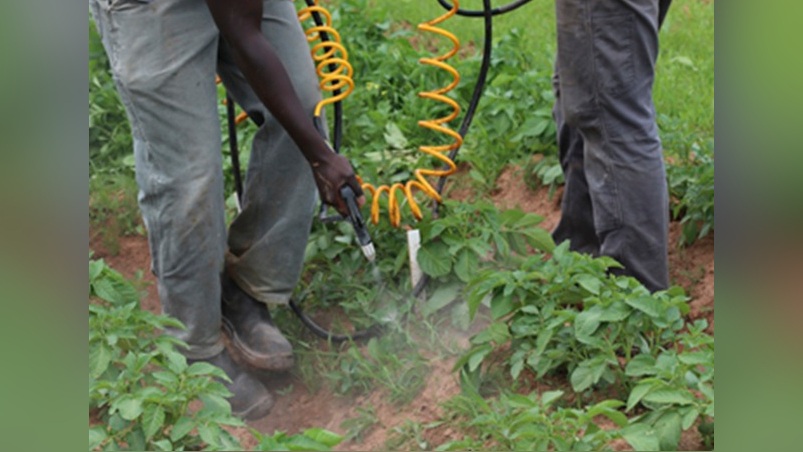
Projectile weed control with baking powder part of a study by Agriculture and Agri-Food Canada researchers (Image Credit: Submitted/Agriculture and Agri-Food Canada)

Scientists targeting troublesome weeds with unique methods

Sep 25, 2026 | 5:03 PM

What if a simple kitchen staple like baking soda could help Canadian farmers tackle stubborn weeds?   

Agriculture and Agri-Food Canada (AAFC) research scientist, Dr. Andrew McKenzie-Gopsill recently completed research that explored an alternative method for controlling weeds.    

He investigated a technique called abrasive or projectile weed control. Using a sandblaster, McKenzie-Gopsill shot natural materials like corn cob grit and baking soda at weeds and found that they can knock back even the most stubborn plants, like lamb’s quarters and wild buckwheat, without damaging potato plants or reducing potato yields. It provides farmers with new tools for fighting invasive weeds in high value crops where herbicides are becoming less effective due to resistance.   

Early research for the project combined abrasive grits, like corn cob, with reduced herbicide rates. The simple idea was to weaken weeds with a blast of grit, then finish them off with herbicide. While it worked, it came with a catch. Using lower herbicide rates can actually encourage herbicide resistance. That’s a risk that Canadian farmers and weed scientists have spent decades trying to avoid.    

In the second phase, they dropped reduced-rate herbicides and instead paired the projectile materials with a bioherbicide, an all-natural weed control product, applied with a hooded sprayer that shields the crop while targeting weeds beneath the crop canopy.   

McKenzie-Gopsill found that both corn cob grit and baking soda, when combined with a bioherbicide, controlled weeds like lamb’s quarters and wild buckwheat quite well, with baking soda emerging as the most effective projectile material.   

 “We saw good control on problematic weeds with baking soda without any yield loss or damage to the potato plants,” he said.  

While the innovative weed control method has shown promise, the sourcing and cost of projectile materials remain an obstacle for farmers. The team noted that farmers who grow high value crops like vineyard grapes or organic crops that have limited herbicide options could benefit most from using projectile weed control.    

Traditional herbicides can’t be used in organic crop production, and organic farmers rely on hand weeding, which is costly and time consuming. Pairing projectile weed control with an organic bioherbicide provides these farmers with another option in their weed-fighting toolbox.   

 McKenzie-Gopsill said it could even help reduce agricultural waste.   

“Some projectile materials like corn cob grit can be acquired from processors that have it as a waste product. This can reduce costs for farmers as well as divert materials that might have been bound for the landfill,” he said.  

Weed hunters like Dr. McKenzie-Gopsill have shown that blasting weeds with grit and natural products can work. Like many innovations in agriculture, success depends on where and how it’s used. For now, this approach is best suited to specialized, high-value crop production systems. 

–

alice.mcfarlane@pattisonmedia.com