Click here to sign up for our free daily newsletter
Fighting back

Canada’s retaliation plan against 25 per cent tariffs still largely unknown

Feb 2, 2025 | 8:26 AM

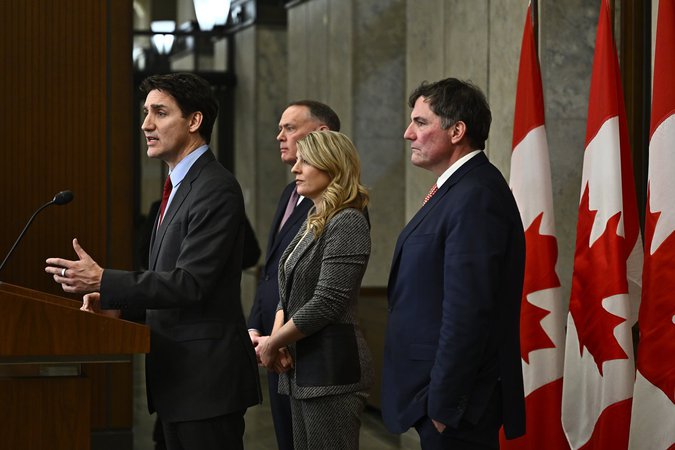
OTTAWA — Prime Minister Justin Trudeau announced last night Canada will respond with retaliatory tariffs after U.S. President Donald Trump confirmed 25 per cent tariffs against the country would go into effect Tuesday, but the entirety of Canada’s plan to fight back remains largely unknown.

Trudeau said Saturday night Canada will respond to Trump’s threat with 25 per cent tariffs against $155 billion worth of American goods, including alcohol, furniture and natural resources.

“This will include immediate tariffs on $30 billion worth of goods as of Tuesday, followed by further tariffs on $125 billion worth of American products in 21 days’ time to allow Canadian companies and supply chains to find alternatives,” he said.

Trudeau said the Canadian tariffs response would also be far reaching, including “everyday items such as American beer, wine and bourbon, fruits and fruit juices, including orange juice, along with vegetables, perfume, clothing and shoes.”

“It will include major consumer products like household appliances, furniture and sports equipment and materials like lumber and plastics, along with much, much more.”

Trudeau did not answer whether Canada would consider cutting energy supplies to the U.S. in light of tariffs, saying instead any measures that involve one region of the country more than others will be done “carefully” and with the full partnership of regional leaders.

A full list of items Canada is targeting could be released as early as today.

The news came after Trump said any retaliatory measures from Canada could be met with increased tariffs.

Provincial leaders appeared to be in line with Trudeau’s messaging about protecting the Canadian economy and its relationship with it’s southern neighbour on Saturday, while acknowledging the momentous challenge ahead for the country.

Trudeau urged Canadians that this was also the “time to choose Canada.”

“There are many ways for you to do your part. It might mean checking the labels at the supermarket and picking Canadian made products. It might mean opting for Canadian rye over Kentucky bourbon, or foregoing Florida orange juice altogether,” Trudeau said.

“It might mean changing your summer vacation plans to stay here in Canada and explore the many national and provincial parks, historical sites and tourist destinations our great country has to offer.”

In his address, Trudeau also attempted to reassure Canadians by saying, “we are all in this together”.

“The coming weeks will be difficult for Canadians, and they’ll be difficult for Americans,” Trudeau said.

“The level of cooperation, the level of effective partnerships between our two countries that have been established over decades and generations means that this trade action by the Americans and our response is going to have real consequences for people, for workers on both sides of our border,” he said.

“We don’t want to be here. We didn’t ask for this, but we will not back down in standing up, both for Canadians and for the incredible, successful relationship and partnership between Canada and the United States.”

Trudeau added that “no one part of the country should be carrying a heavier burden than any other.”

“Any conversations around further measures, particularly involving one industry or one region of the country more than another, is something that we’re going to do carefully and thoughtfully and with the full partnership of regional leaders, provincial premiers, businesses.”

As previously signalled, the U.S. tariffs would be 25 per cent across the board with an exception on energy which will be 10 per cent.

Trudeau said he had been unable to reach Trump to talk about the issue on Saturday.

When asked if he was going to recall parliament and end prorogation to address the tariffs, Trudeau said that the government already had the tools to deal with the issue.

Conservative Leader Pierre Poilievre is expected to address the media at a news conference in British Columbia this morning in light of Trump’s announcement.

Scott Moe makes statement on social media

Saskatchewan Premier Scott Moe’s last-minute appeal to Trump on Friday appears to have fallen on deaf ears.

“We would ask the Trump administration to not put those tariffs on, and we would also ask our federal government to address the priorities that President Trump has raised,” Moe told reporters at the legislature.

“When you break down what has really been articulated as a priority for the President (Trump), it is stopping fentanyl, stopping illegal migrants and our NATO commitment,” Moe said

He also said he thought many Canadians would agree with Trump on fentanyl.

“it’s not a drug at all. It’s poison,” he said. “It’s killing our families and our friends and our community members across this across the nation.”

Moe made a statement on social media on Saturday, before the federal response was announced.

Sask. NDP Leader Carla Beck once again called for an emergency return of the legislature to mount an immediate response to protect people’s jobs and livelihoods.

Earlier Friday, Prime Minister Justin Trudeau said Canada is ready to deliver a “purposeful, forceful but reasonable immediate” response to the tariffs. The federal government has said it has multiple options for retaliatory tariffs ready to deploy, depending on what Trump ultimately does.

Moe also reiterated on Friday previous comments that he thought retaliatory tariffs would be counter-productive.

Terry Duguid, federal Minister for Prairies Economic Development Canada, said last week the country is prepared for various scenarios of tariffs from Trump.

“We’ve been working on these for months, ever since Trump was was re-elected,” Duguid said.

“We will be ready. We will be strong. We will stand up for the prairies in Canada, and I’m very confident that the ministers who are front and center in this are very prepared.”

Duguid said he can’t speak to the tariffs plan until they are actually put in place, but said the federal government is prepared for anything.

“Everything is on the table,” he said. “We’re not going to reveal our hand until we do hear something final … We see the goal-posts moving every day. So I think we have to be calm and patient, but we have to be ready. And I think we are.”

Moe said the Saskatchewan government had been in meetings with various industry leaders in the agriculture, fertilizer, mining and oil and gas industries on “maybe diverting some of those products to other markets” if tariffs are imposed.

“We are an exporting province, certainly, and we are the highest exporting province of any in Canada, so we are concerned,” Moe said.

But … in Saskatchewan we are the least dependent province on our exports to the United States. That being said, they’re our largest trading partner, our most important trading partner and an ally so this scenario that we find ourselves in is both concerning and challenging.”

–With files from CKOM

This report by The Canadian Press was first published Feb. 2, 2025.

The Canadian Press